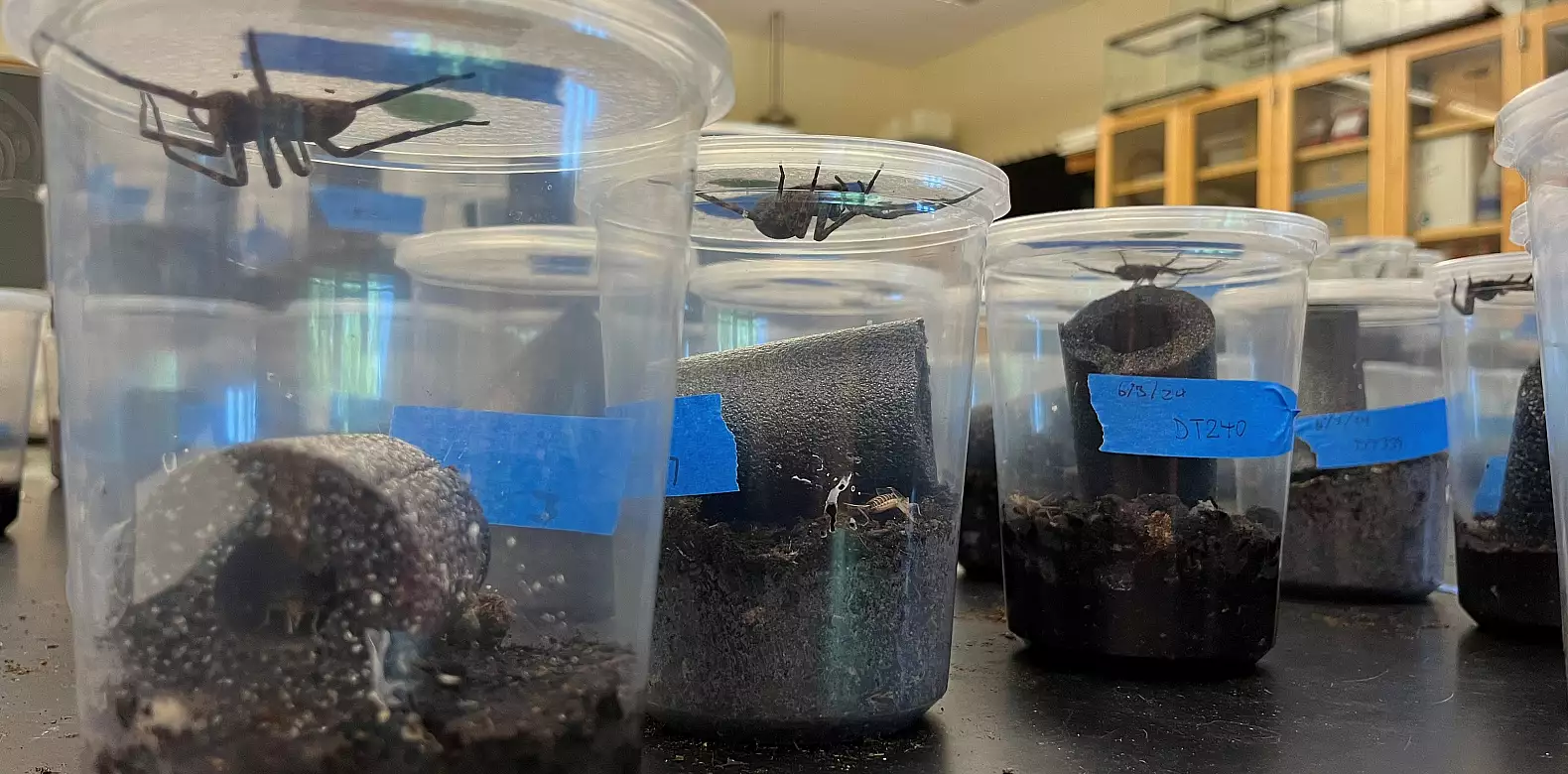
Students at 体育买球官网 University are collecting hundreds of spotted lanternflies and spiders to determine if the spiders will eat the invasive insect.
“Currently, there is no comprehensive control plan for these insects, which are an issue of economic concern because they can destructively feed on at least 56 plant species, including commercially important ones such as grape and stone fruit,” said Matthew Persons, professor of biology in 体育买球官网 University’s School of Natural & Social Sciences. “We are experimentally feeding spiders different developmental stages of the lanternfly — from nymphs to fully mature insects — to determine which spiders, if any, are predators of the insect and under what circumstances.”

Persons and four of his students have collected nearly 800 spiders of varying species on the grounds surrounding 体育买球官网’s campus; they hope to increase that number to 1,000. They have also collected spotted lanternfly nymphs, which is the insect’s current stage, from tree of heaven (its preferred host plant) and other plants. It is believed that through feeding on tree of heaven, lanternflies acquire protective toxins — toxins that might make them unpalatable to spiders.
“We’re already seeing that the nymphs don’t appear to be afraid of the spiders, so that’s a good indication that the lanternflies are carrying some kind of chemical protection,” Persons said.
Back at the lab, the spiders undergo an onboarding of sorts — they are identified, weighed and fed. One week later, after the spiders have developed an appetite, the students offer them a lanternfly nymph.
“We are observing the spiders to see if they attack the lanternflies, how long it takes and if the spider actually consumes it,” explained Marissa Defino ’25, a biology major from Fair Lawn, New Jersey.
Students are testing to see which spiders, if any, eat the nymphs and recording what plant the nymph was collected from.
“So far, it looks like the spiders prefer the nymphs gathered from sumac versus tree of heaven,” Defino added.
Students must also determine if the lanternfly was fully consumed, as the presence of a “body” doesn’t always reveal the answer. Different spiders eat their prey differently — some inject venom that liquifies the prey’s insides which are then “sucked out” by the spider; other spiders crunch their prey with their jaws. To get their final piece of information, students must put the lanternfly under the microscope to determine what remains from the insect.

“It’s very detailed work and we’re collecting a lot of data, but what we’re doing here could help to solve a very real problem,” said Steven Reid ’25, a biochemistry major from Warrenton, Virginia.
The students will continue to collect spotted lanternflies at every stage of their development to determine if spider predation changes.
If the spiders are willing to eat lanternflies — in any stage of development — then the arachnids could be used as a biocontrol mechanism to tamp down the lanternfly’s spread, Persons explained. But this kind of ecological research is becoming more and more confused as “biological pollution” worsens.
“The project we are working on this summer has obvious implications — what happens when new species are introduced?” Persons said. “But with the introduction of more and more invasive species, it becomes progressively more difficult to predict the effects these species may have. What we are seeing with the lanternfly speaks to a much larger issue, which is the threat that invasive nonnative species pose to ecosystems when they disrupt the balance and lead to the decline of native species and habitats. Regarding the lanternfly specifically, the introduction of the tree of heaven allowed them to expand their range quicker than they otherwise likely would have been able to.”