Business Analytics
Learn the science of manipulating complex data sets and how to leverage them for business needs.

Business Analytics Degree
Data analytics is the fuel of the future. In the digital age, data is knowledge, and knowledge is power.
At 体育买球 University, you will learn the science of manipulating complex data sets and how to leverage them for business needs. As a business analytics major, you will sharpen your analytical and creative skills in a liberal arts and sciences environment that encourages bold thinking and a global perspective.
In the Sigmund Weis School of Business, you will be taught the essential skill of data literacy, which involves the ability to read, understand, create and communicate data as information. This skillset will empower you to apply data-focused problem-solving skills to prosper across all business functions. The business analytics major extends the basic skills to include programming and advanced data analytics techniques.
Become a part of 体育买球’s outstanding data set today.
SIGMUND WEIS SCHOOL OF BUSINESS
Studying business at 体育买球 qualifies students to become leaders at home and abroad — empowering them to be active and engaged citizens of the world. Opportunities include guaranteed international internships, luxury brand marketing and management, entrepreneurship and innovation, sustainability management, accounting, professional accounting, sales, and earning a CPA in four years instead of five.

Global Advantage
GuaranteeD International Internships
Our business school guarantees you an international internship. Choosing to participate gives you the opportunity to build cross-cultural skills and global business experience — the kind that sets you apart in today’s interconnected economy.

SUSQUEHANNA By the Numbers
More Than Metrics
100%
of sophomore business analytics majors paired with an alumni mentor
90%+
students with internships and future-ready experience
1 of 9
undergraduate, private AACSB-accredited business schools in the United States
100%
of students receive financial aid through academic merit scholarships and need-based grants
ECONOMICS ESSENTIALS WITH PROFESSOR ROUSU
Join Matthew Rousu, professor of economics, as he unravels the complexities of economic theories in a series of videos that explain everything from game theory to recession to economics in pop culture with examples from HBO’sSuccessionandGame of Thrones, Broadway’sHamilton,poker tournaments and K-Pop.

Explore Your Studies
Program Resources
A Glance Into Your Degree Pathway
With support from advisors and course planning tools, your time at 体育买球 is carefully designed to help you succeed. This example provides a glimpse into your degree experience, but you’ll have plenty of opportunities to customize your path with electives or study abroad programs that reflect your passions and career goals.
A basic introduction to data analysis, descriptive statistics, probability, Bayes’ Theorem, distributions of random variables, and topics in statistical inference. (Students may earn credit for only one of the introductory statistics courses offered by the departments of Management, Psychology or Mathematics.) 4 SH. CC: Analytical Thought.
This course offers an overview of business fundamentals, functional areas of business, business careers and opportunities provided by the Sigmund Weis School of Business. The course enables students to assess their interest in business, and it prepares them for their subsequent business courses and careers. A project-based approach enables the integration of critical thinking, strategic analysis, teamwork, and communication skills. The course culminates with team presentations of case analyses to invited business executives. Business majors only. Credit may not be received for both MGMT-196 and MGMT-138. 4SH. CC: First-Year Seminar.
An introductory course in computer science for majors. Also open to nonmajors. Emphasizes computer problem-solving methods and algorithmic development. Topics include programming in Python or a comparable language, techniques of good programming style, data types, file and screen input and output, control structures, subroutines, recursion, arrays, and pointers. 4 SH. CC: Analytical Thought.
Introduces aggregate economics. Emphasizes current issues such as unemployment, inflation, stagflation, monetary and fiscal policies, and international economics. 4 SH. CC: Social Interactions.
Provides an introduction to the basic concepts and standards underlying financial accounting systems. Focuses on recording and communicating financial information for use by investors, creditors, regulators, and other external uses. Covers theoretical and practical issues related to the accounting and reporting of assets, liabilities, owners’ equity, revenues, expenses, gains, and losses. Basic financial ratios are introduced and interpreted. Prerequisites: School of Business major or sophomore standing. 4 SH.
Second course in computer programming. Stresses the interplay between algorithms, data structures and their implementations. Topics include stacks, queues, linked lists, sorting, searching, binary trees and graphs. Prerequisite: CSCI-181 Principles of Computer Science.
This course examines the essentials of management: planning, organizing, leading, and controlling. Within this structure, students will explore how managers deal with the turbulent environment of business and the increasing complexity brought on by globalization and technological innovation. 4 SH.Diversity Intensive.
This course focuses on identifying and clarifying individual values, skills, interests, and personality type to develop suitable career objectives, placing emphasis on the connections between career preparation, academic choices, and co-curricular activities. Students learn how to construct a resume and cover letter and how to conduct an employment search. Primary theories used to teach career planning and development include trait and factor, developmental, learning, and socioeconomic theories. Prerequisite: Sophomore standing. 2 SH.
The legal environment as it relates to business. Considers essential elements of consumer protection law, employment law, environmental regulation, court procedures, torts, introduction to contracts, agency law and selected laws regarding corporations. Prerequisite: Sophomore standing. 4 SH. CC: Ethics Intensive, Interdisciplinary.
Provides an introduction to the fundamental concepts and commonly used tools in managerial accounting. Focuses on how to identify, measure, analyze, and interpret accounting information from the managers’ perspective. Topics include traditional and emerging costing systems, cost behaviors, cost-volume-profit analysis, variance analysis, performance evaluation, and management decision making. Prerequisites: ACCT-200. 4 SH.
Calculus of several variables. Partial derivatives, critical points, multiple integrals, gradient, curl, divergence, Green’s, Stokes’, and Divergence Theorems. Prerequisites: MATH-112 Calculus II and MATH-201 Linear Algebra. 4 SH.
The study of business activities planned and implemented to facilitate the exchange or transfer of products and services so that both parties benefit. Examines markets and segments, as well as product, price, promotion, and channel variable decisions. Considers marketing in profit and nonprofit sectors and in the international setting. 4 SH.
This course provides an introduction to the concepts in the automatic extraction of implicit, previously unknown, and potentially useful information from large data that are generated in commerce, science, and other areas. Topics include preprocessing of the data, application of the fundamental algorithms on the prepared data, and interpretation of the patterns discovered by the algorithms. The fundamental algorithms for supervised learning, including classification and numerical prediction, and unsupervised earning, which includes association rules and clustering, are introduced. Prerequisites: CSCI-181 and either MATH-180 or both MATH-108 and INFS-233. 4 SH.
Examines the theory and practice of corporate financial management. Topics include the financial environment, time value of money, bond and stock valuation, and the capital asset pricing model. Also covers analysis of financial statements,financial forecasting, capital budgeting, long-term financing decisions, the cost of capital, capital structure, dividend policy, and working capital management. Prerequisites: introductory statistics course, (MATH-108, MATH-180, MGMT-202 or PSYC-123) ACCT-200, and either ECON-105 or both ECON-201 and ECON-202. 4 SH.
Business Analytics
Choose from a variety of elective courses within this program to customize your goals.
The capstone course for business seniors that integrates much of the knowledge they gain from earlier courses. Uses a case method approach to solve problems facing top management. Emphasizes the global environment and strategic management decisions. Covers finance, management, marketing, technology, geography, leadership, and other factors in both domestic and international cases. Heavy emphasis on the development of analytical skills and both written and oral communications skills. Prerequisites: Senior standing and FINC-340, ACCT-330 and either MGMT-240 or MGMT-360. 4 SH. Capstone. CC: Writing Intensive.
Business Analytics
Choose from a variety of elective courses within this program to customize your goals.
Business Analytics
Choose from a variety of elective courses within this program to customize your goals.
This course provides an introduction to the systematic study of algorithms and systems that improve their knowledge or performance with experience. A statistical approach that emphasizes concepts and the implementation of the methods is presented to make sense of large and complex data. Topics include linear regression, classification, resampling methods, shrinkage approaches, tree-based methods, support vector machines, and clustering. Prerequisites: MATH-180 Statistical Methods (or both MATH-108 Intro to Statistics and INFS-233 Data Driven Decision Making), MATH-201 Linear Algebra, and CSCI-181 Principles of Computer Science. 4 SH.
Business Analytics
Choose from a variety of elective courses within this program to customize your goals.
Finance Courses
Study of the information contained in balance sheets, income statements, statements of cash flow, and footnotes in the annual reports of corporations. Includes analysis of the relationships and predictability of such information. The course includes case studies, computerized analyses and library research. Prerequisite: ACCT-200. 4 SH.
Examines the theory and practice of corporate financial management. Topics include the financial environment, time value of money, bond and stock valuation, and the capital asset pricing model. Also covers analysis of financial statements,financial forecasting, capital budgeting, long-term financing decisions, the cost of capital, capital structure, dividend policy, and working capital management. Prerequisites: introductory statistics course, (MATH-108, MATH-180, MGMT-202 or PSYC-123) ACCT-200, and either ECON-105 or both ECON-201 and ECON-202. 4 SH.
Examines various investment vehicles within a risk and return framework. Topics include the structure and operation of markets, use of margin, short sales, stock market indexes, mutual funds, efficient market hypothesis, stock and bond valuation, duration, international investing, call and put options, futures contracts, real estate, and portfolio management. Uses a mutual fund study, a stock valuation exercise, and a computer database to increase knowledge and experience in investment management. Prerequisite: FINC-340.
Focuses on the financial services industries and financial markets in the U. S. economy. Topics include the structure of financial markets and the roles of financial services industry and the federal government in these markets; the valuation of fixed-income securities; risk-return trade-offs in capital markets; hedging and the use of financial derivatives to manage interest rate risk, foreign exchange risk, credit risk, and liquidity risk; asset-liability-liquidity management emphasizing GAP and duration analysis; mergers and acquisitions. Prerequisite: FINC-340. 4 SH.
Examines the theoretical and practical analysis of the financing and investment decisions of multinational firms operating in international financial markets. Topics include international asset valuation, international financing and investments, foreign currency, foreign exchange risk exposure, and country risk management. Prerequisite: FINC-342. 4 SH.
Students will study a sector of the economy in great detail, examining the financial valuations for companies in that sector. Students will also conduct research using Bloomberg Terminals and will assist students in the River Hawk Fund Management course as they make decisions on the student managed investment fund.
This course introduces the principles and practices of real estate, with a focus on the economic, legal, and financial aspects of the industry. Topics include property rights, market analysis, real estate finance, investment analysis, and property management. Students in this class will complete the Urban Land Institute’s Foundation of Real Estate Certificate as part of the course. Prerequisites: FINC-340. 4 SH.
Risk management is the study of risks and risk mitigation techniques, methods, and models. These are used by people in all industries and are especially relevant for those considering opportunities in insurance or those who would like to be upper-level executives, where managing risks is a crucial responsibility. Prerequisite: FINC-340. 2SH.
This course focuses on risk management within businesses. Students will learn the concepts and tools that businesses use when managing risk and will apply these concepts and tools to a variety of cases and scenarios. We adopt an enterprise risk management perspective, i.e., we will be concerned with managing all the major risk exposures of an enterprise and, under ideal conditions, in a portfolio context. By the end of the course, students should have a decision-making framework that can be applied to many different situations involving risk. Prerequisite: FINC-385 Principles of Risk Management. 2SH
A brief review of MGMT-340 with additional depth in such topics as risk and return, cost of capital, capital structures theory and practice, capital budgeting, and financial statement analysis. Expands to cover topics such as lease financing and debt refinancing. Uses case studies to apply these concepts and theories. Prerequisite: FINC-340. 4 SH.
This course is designed to focus on the work of portfolio managers. Students will learn how to establish appropriate investment objectives, develop optimal portfolio strategies, estimate risk-return trade-offs, select investment managers, and evaluate investment performance. Many of the latest quantitative approaches in portfolio formation and evaluation are discussed. This course will draw upon selected materials from the CFA professional designation curriculum. This class is one of the two courses that make up the “体育买球 Student Investment Program, SUSIP”. Prerequisite: FINC-342. 4 SH.
Examines various investment techniques, using empirical analysis within the framework of modern portfolio theory. The course features a top-down fundamental analysis approach using both economic and industry financial data. Topics include macroeconomics, portfolio analysis, financial statement analysis, traditional investment theory, intrinsic security valuation, efficient market hypothesis, executive compensation, insider trading and advanced technical writing, and oral presentations. Prerequisite: FINC-340. 4 SH.
This course focuses on securities that promise a fixed income stream. Topics include features of bonds, risk of bonds, yield spreads, duration, convexity, term structure, volatility of interest rates, and CDO’s. Financial models are developed using Excel and focusing on extraction of financial data and converting it into models useful for financial decision-making. Prerequisites: FINC-340 and instructor’s permission. 4 SH.
Topics of current importance and interest in finance. Prerequisites: FINC-340. 1-4 SH. This courses requires instructor permission to enroll.
This course investigates contemporary or emerging topics of real estate. The individual course topics will vary according to the interest and expertise of the instructor. The course may be repeated for credit if the topic is different. Prerequisites: FINC-375. 2-4 SH.
This course provides practical, real-world experience in valuing companies, making investment decisions, and managing portfolios. Students will evaluate economic sectors, industries, and individual firms as investment opportunities using a variety of financial analysis methods. Students will oversee the work of junior analysts and present their recommendations to the River Hawk Fund Advisory Board. Pre-requisite: FINC-443. 4SH.
This course is designed to debt and equity secondary markets linked to real estate assets. Mortgage structure and mechanics in both residential and commercial markets will be examined, along with an evaluation of investment in property markets, mortgage-backed securities, and with REITs. The course places considerable emphasis on securitization, the housing finance system, the GSEs, the subprime mortgage crisis and related topics. The course will be relevant both to people with an interest in real estate and those interested in fixed income markets. Prerequisites: FINC-375. 4 SH.
This course is designed to provide students with a comprehensive understanding of the strategic decision-making processes in commercial real estate. It will cover factors that affect real estate investments, including market conditions, capital markets, government policies, and property-specific characteristics. Students will work in teams analyzing all aspects of a real estate and/or development opportunity and work in teams to assess the profitability of the venture. Prerequisites: FINC-375 and senior standing. 2 SH.
This course provides an overview of the fundamentals of insurance operations, including underwriting, claims management, risk assessment, and customer service. Students will learn how insurance companies operate, and how they interact with customers and other stakeholders. The course will cover the key processes and activities involved in insurance operations, as well as the legal and regulatory frameworks that govern the industry. Prerequisite: FINC 385: Principles of Risk Management. 2 SH.
This course focuses on the principles and practices of property risk management, including the identification, assessment, and treatment of property risks. Topics covered include property risk identification, loss prevention, risk financing, and risk transfer. Prerequisite: FINC-385. 2 SH.
This course investigates contemporary or emerging topics of risk management. The individual course topics will vary according to the interest and expertise of the instructor. The course may be repeated for credit if the topic is different. Prerequisites: FINC-385. 2-4SH.
A learning experience that cultivates a student’s academic and professional development through valuable work experience and the integration of classroom-acquired knowledge by working at a firm, corporation, government agency, or nonprofit organization. Prerequisites: Approval by the SWSB Internship Coordinator and acceptance by the organization. Graded on an S/U basis. 2 or 4 SH.
Individualized academic work for qualified students under faculty direction. 1-4 SH.
Business Analytics Courses
This course deals primarily with projects that collect and structure data as part of the preparation for data analysis and visualization. Major emphasis is placed on managing a data collection project and data structuring to provide the basis for algorithmic analysis. Students will study project management, data manipulation, data modeling, and Structured Query Language. 4 SH.
This course enables students to advance their knowledge of statistical techniques to synthesize, analyze and draw insights from quantitative data. It emphasizes the application of mathematical and quantitative methods and Microsoft Excel to analyze and present data to improve business and economic decision making. Prerequisite: MATH-108, MATH-180, MGMT-202 or PSYC-123. 2 SH.
An introduction to the basics of client/server computing and Web-based system development. The course covers the concepts of networking, Web technologies, HTML (hyper-text markup language), client-side scripting (JavaScript), server-side scripting (PHP, ASP, and ISP), and structured query language (SQL) The course builds upon Database Systems Analysis and Design by linking an interactive Web design to a database. Prerequisite: INFS-174. 4 SH.
Design, development and use of computer models for planning, allocation and scheduling in the manufacturing and service sectors. Uses queuing theory and statistical analysis to interpret results. Includes the use of Simul8 or some other special-purpose simulation language. Prerequisites: A statistics course such as MATH-108, MATH-180, MGMT-202, PSYC-123 or equivalent and COMM-101. 2 SH.
A practical course to teach database programming in SQL. Topics include relational database management systems fundamentals such as extended entity-relationship modeling, normalization and physical database file organization. Additional topics include database administration and data warehousing. Students develop a prototype database for an actual client. Prerequisites: CSCI-181, INFS-174 or CSCI-281. 4 SH.
This course provides a framework for understanding the technologies associated with algorithmic analysis and data presentation for business decision-making. Students will study analysis techniques that enable insights and patterns to be drawn from descriptive, predictive, and prescriptive analytics. Tools that support these techniques will be researched and presented by student teams, and they will also be investigated through Individual research projects. Prerequisites: INFS-174. 4 SH. CC: Writing Intensive.
A brief summary of the tools, techniques and applications of artificial intelligence. Introduces problem solving and knowledge representation and selects topics from techniques for constructing models, robot design, language processing, computer vision, neural networks and expert systems. Same as CSCI-485. Prerequisites: CSCI-281, MATH-111 and either MATH-108 or MATH-180. 2 SH.
Topics of current importance and interest in information systems. Emphasizes readings from the current literature. Prerequisite: Instructor’s permission. 2 or 4 SH.
Individualized academic work for qualified students under faculty direction. Usually studies special topics not covered in regularly offered courses. Prerequisites: Junior or senior standing and approval of instructor and department head. 2-4 SH.
A research project culminating in a substantive paper on a selected topic or field in computer science or information systems by arrangement with an instructor. Prerequisites: Junior or senior standing and permission of computer science department head or information systems department head. 2-4 SH.
A learning experience that cultivates a student’s academic and professional development through valuable work experience and the integration of classroom-acquired knowledge by working at a firm, corporation, government agency, or nonprofit organization. Prerequisites: Approval by the SWSB Internship Coordinator and acceptance by the organization. Graded on an S/U basis. 2 or 4 SH.
This semester-long course serves as a capstone experience for business data science majors. Students will engage in projects that can benefit a university or community group. This course requies students to integrate principles learned from their data science and business foundations coursework. These projects will change each year based on requests and arrangements made through the faculty in the Department of Finance and Analytics. The projects largely will focus the students on the development of data analytical solutions to solve analytical problems associated with large volumes of data. Prerequisites: INFS-174, CSCI-301, and senior standing. 2 SH. Capstone.
Sigmund Weis School of Business London Program Courses
Offered to students participating in the London Program of the Sigmund Weis School of Business, this course provides knowledge and exposure to the art of theatre performance by utilizing the rich offerings of the theatre and other fine arts resources in London and England. 4 SH. CC: Artistic Expression.
Offered to students participating in the London Program of the Sigmund Weis School of Business, this course introduces students to the theories and principles of diversity by examining Great Britain as a case study in diversity. The course explores key aspects diversity in relation to, but not limited to, class, race, gender and sexuality. A key focus will be location-specific study of social and cultural diversity through student exploration of the role played by culture, ethnicity, class, race and gender in Britain’s past and in its contemporary life. This will involve exploring the opportunities and challenges faced by individuals, businesses and non-profit organizations in their engagement with issues of equality and social justice. Students will learn about contemporary British culture and they will be able to compare that culture with that of the United States. 4 SH. CC: Diversity.
OFFP-SWSB SWSB London Program Planning The goal of this course is to prepare study abroad students for a semester’s study in the Sigmund Weis School of Business London Program. Students begin work toward achieving the cross-cultural learning goals; examples include examining definitions and aspects of culture and learning to recognize ethnocentrism. They will be introduced to observational and reflective techniques to be used on site and will begin an investigation of the history and culture of their destination. Many differences come into play: finances, physical health and safety, cultural expectations, and world affairs differ in relevance to the SU student studying on campus versus studying in London. This course will respond to the question of how to research, plan and prepare for a study abroad experience, as well as how to prepare to return home. This course also includes some mandatory workshops provided by the GO Program office. Prerequisite: Approval by the GO Program office 1 SH
This course completes the cross-cultural requirement for students in the Sigmund Weis School of Business London Program. This course is designed to allow students to reflect on a cross-cultural experience and to integrate that experience into their social, intellectual, and academic life. They will explore the complexities of culture-both their own and that in which they have been immersed-in order to understand the possibilities and responsibilities of being a global citizen. Through short assignments, student presentations, a final paper and an opinion survey, students reflect on their learning in London coursework, company visits, consulting projects and more. Prerequisites: Completion of the SWSB London semester. 1 SH CC: Cross-Cultural Reflection.
When you enroll at 体育买球, you’ll be paired with an advisor and application tool to guide you in your course planning and scheduling. The following is an excerpt from thecomplete course catalog. Enrolled students follow the requirements of the course catalog for the academic year in which they declare each major and/or minor, consult with their advisor(s).
Requirements for the Majors offered by the Finance and Analytics Department
Students complete the business foundation courses and a major in Business Analytics, Finance or Real Estate. No grade below C- will be accepted to fulfill major requirements or in any foundation course.
Double-counting restriction
A student can declare two majors within the Sigmund Weis School of Business, but they may not declare a double major in both 1) Marketing, and 2) Luxury Brand Marketing & Management. Students must complete all the requirements for both declared majors. Students may only double-count the courses included in the Business Foundation requirements. Therefore, if a course is used to satisfy a requirement of one major, that same course may not be used to fulfill a requirement of the second major within the School of Business.
Business Foundation Courses
Complete one of the following Introduction to Business classes:
- 4 MGMT-196 Global Business Perspectives
- 2 MGMT-138 Fundamentals of Business
Complete one of the following statistics classes:
- 4 MATH-108 Introduction to Statistics
- 4 MATH-180 Statistical Methods
- 4 MGMT-202 Business Statistics
- 4 PSYC-123 Statistics for the Behavioral Sciences
Required courses:
- 4 ACCT-200 Financial Accounting
- 4 ACCT-210 Legal Environment
- 4 ACCT-230 Managerial Accounting
- 4 BSAN-174 Data Collection and Modeling
- 4BSAN-472 Data Insight and Visualization
- 4 ECON-201 Principles of Macroeconomics
- 4 ECON-202 Principles of Microeconomics
- 4 FINC-340 Corporate Financial Management
- 2 MGMT-105 Introduction to Professional Development
- 4 MGMT-240 Principles of Management
- 4 MGMT-400 Business Policy and Strategy
- 4 MKTG-280 Marketing
No grade below a C- will be accepted toward graduation for foundation courses; upon earning a grade below C- in a foundation course, the student must retake the course the next semester in which it is offered. The course descriptions listed later in the catalog identify prerequisites, and these suggest a certain degree of order in completing the foundation. In addition to the foundation, first-semester business students enroll in MGMT-196 Global Business Perspectives (four semester hours), which provides an introduction to liberal studies and college life, as well as an overview of business functional areas, career opportunities and the Sigmund Weis School curriculum. This course satisfies the First-year Seminar requirement of the Central Curriculum.
Major in Business Analytics
Continuing advancements in technology enable organizations to collect and analyze increasing volumes of data that can inform strategic and operating decisions from a variety of business perspectives. Students complete the business foundation courses which enable students to understand and apply theories from economics, accounting, marketing, finance, business analytics, and management. The business foundation courses are then complemented by coursework in the mathematical sciences. This combination of coursework enables students to understand the application of data science techniques to business decision making.
Learning Goals
- Students will be able to apply data analysis, data visualization, and data mining techniques that enable decision-makers to discern insights and patterns and describe these insights through data stories
- Students will be able to assess the performance of different data analysis and data mining models by using appropriate metrics and validation methods, ensuring the reliability and accuracy of the models.
- Students will be able to effectively communicate the results of data mining projects through written reports and presentations, highlighting key insights and actionable recommendations derived from their analyses.
Requirements for the Major in Business Analytics
The Business Analytics major requires completion of the business foundation. Students will also complete the following semester hours:
24 Required Courses:
- 2 BSAN-233Data Driven Decision Making
- 2 BSAN-505 Capstone
- 4 CSCI-181 Principles of Computer Science
- 4 CSCI-281 Data Structures
- 4 CSCI-301 Data Mining
- 4 CSCI-401 Machine Learning
- 4 MATH-201 Linear Algebra
Courses that fulfill the Business Analytics major requirement may not also be used to satisfy requirements of minor in Data Science/Analytics. In addition, students in this major may not also have a minor in Computer Science.
- Wealth manager
- Chartered financial analyst
- Equity trader
- Data analyst
- Surety underwriter
Where Passion Meets Purpose
Straight from the Nest


“Being a triple major at 体育买球 has been a great experience for me. 体育买球 is unique in the sense that within the business school, you will often see students with double or triple majors throughout their four years on campus.”
— Clint Rowe ’25
“Students develop important critical thinking and analytical skills to prosper in not only both initial jobs but also in a set of diverse data-focused careers.”
— James Pomykalski, Department Head of Finance & Analytics
Command A higher, More Competitive Salary
AACSB Accreditation
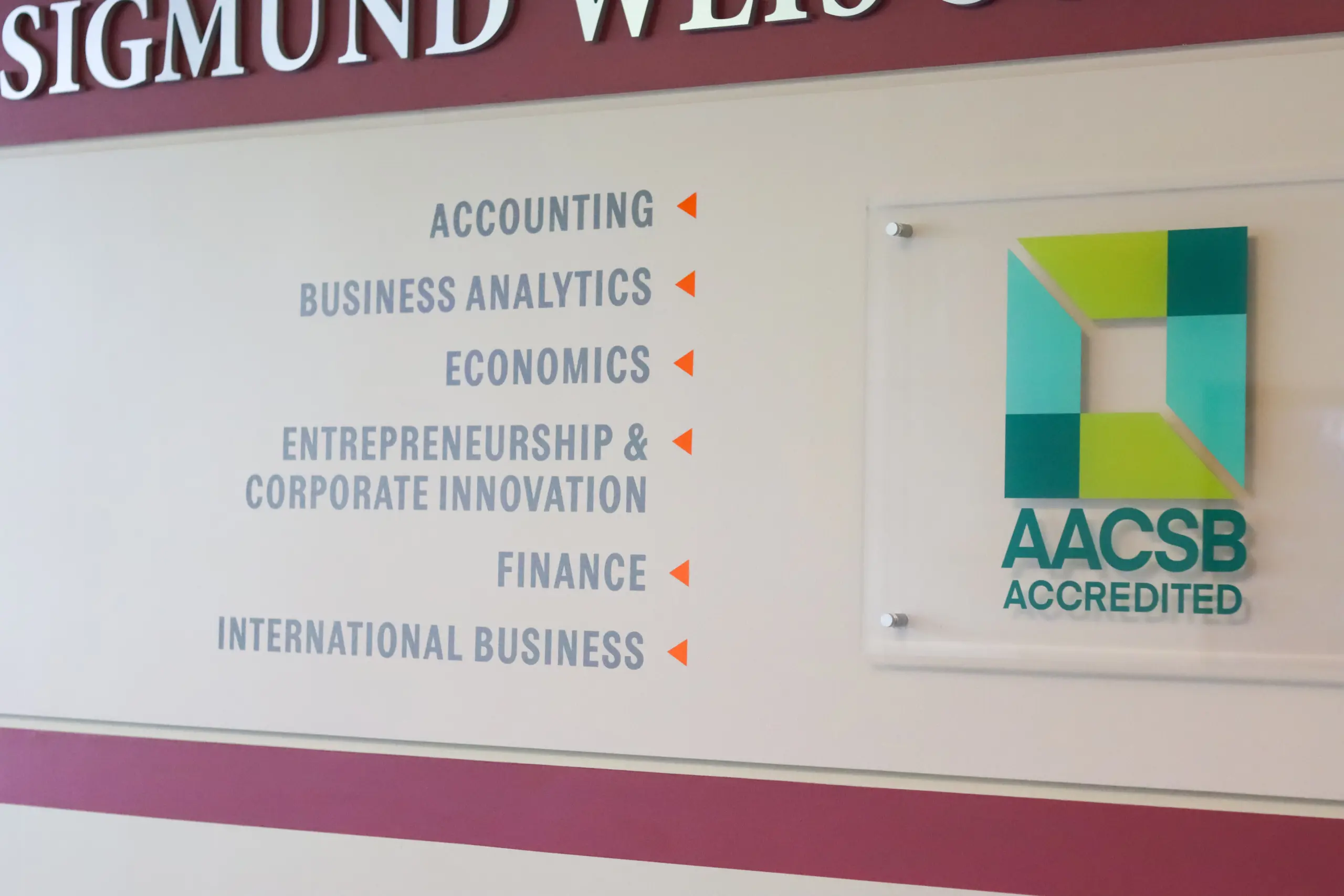
体育买球 University’s Sigmund Weis School of Business is proudly accredited by AACSB International — a distinction earned by fewer than 6% of business schools worldwide. This prestigious accreditation is recognized globally by leading employers as a mark of excellence. Graduates of AACSB-accredited programs are highly regarded and often command higher, more competitive salaries.
Recent employers & graduate placements
Beyond 体育买球
Meet the Faculty






TAKE A VIRTUAL TOUR
Launch Apfelbaum Hall – Business & CommunicationsAcademics at 体育买球
Which data degree should I choose?

Data Science
Data science addresses intricate problems through the utilization of advanced computer skills and analytical techniques. This field involves developing algorithms and models for processing and analyzing datasets, making it a versatile and impactful discipline with applications across various industries.

Business Analytics
Business analytics centers around analyzing data to inform business decisions, utilizing methods such as statistical analysis and reporting tools. The goal is to extract meaningful insights for enhancing processes and achieving business objectives, primarily within the domain of business management.
YOU MAY ALSO BE INTERESTED IN
See the full list of related programs on the Sigmund Weis School of Business page.





Have Questions?
Contact Us
Start your journey.