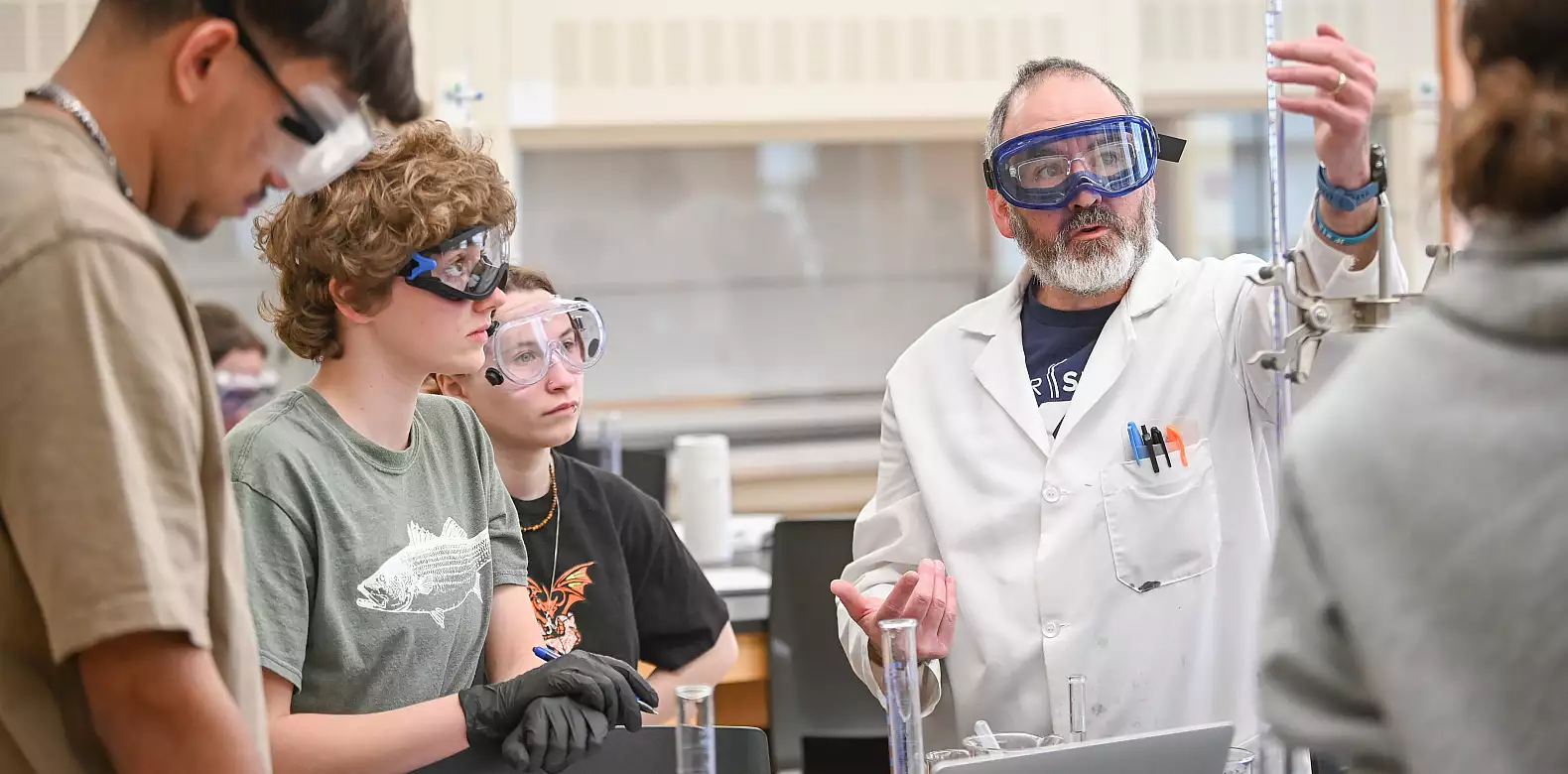
Students in Pavithra Vivekanand’s biology lab are exploring how environmentally friendly and biocompatible gold nanoparticles affect inflammation — and one student researcher has a personal connection to the work.
“We’ve shown that it’s possible to make gold nanoparticles using extracts from ginkgo leaves, as well as with other natural resources such as lemongrass and honey,” Vivekanand, associate professor of biology, said. “Now, we’re exploring whether these particles affect molecules involved in inflammation — both those that promote it and those that help reduce it — and how exactly the particles influence the immune system.”
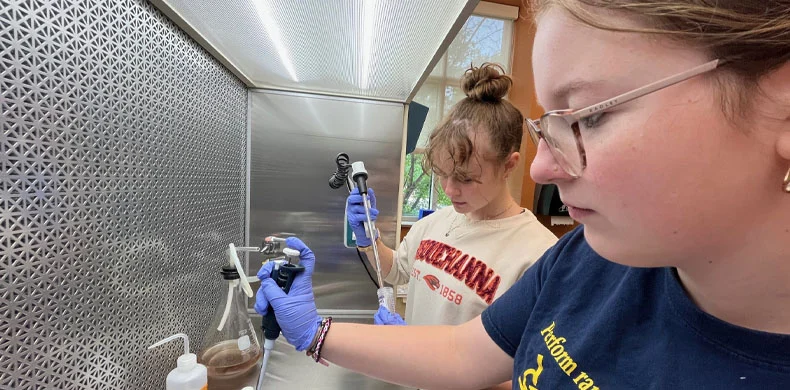
While Nathan Yatsko ’27, a biomedical sciences major from Warrior Run, Pennsylvania, works on making ginkgo gold nanoparticles, Emily Dimmick ’28 and Jenna Waldron ’27 are creating gold nanoparticles from pomegranate juice. Dimmick’s interest in the research is personal, as she is facing a possible diagnosis of rheumatoid arthritis.
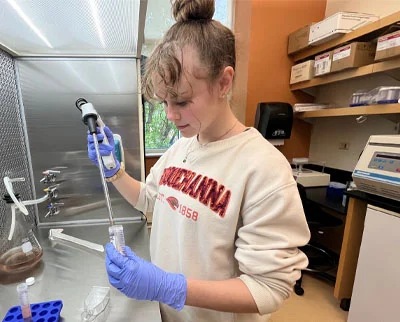
“My work with Dr. Vivekanand is helping me to understand the mechanisms behind chronic inflammatory diseases — not just for the sake of science, but in hopes of improving outcomes for patients like myself,” said Dimmick, a biology major from Northampton, Pennsylvania. “It’s a rare opportunity to turn a personal challenge into a scientific purpose.”
Yatsko, Dimmick and Waldron have faced some challenges creating particles that are small and uniformly sized. Their frustration peaked when they accidentally melted their test tubes in a specialized high-speed centrifuge.
“The nice thing about summer research is it’s a real learning environment,” said Waldron, a biology and Spanish studies double major from Kenvil, New Jersey. “We have room to fail and try something else.”
Gold nanoparticles are traditionally synthesized using commercially available chemical compounds such as sodium citrate, which can be harmful to the body, Vivekanand said.
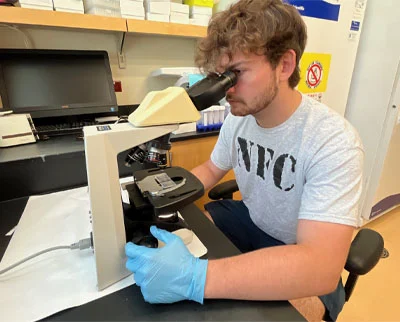
“There are fewer studies on making nanoparticles using plant sources because of the variability you encounter using natural extracts,” Vivekanand said. “The advantage of using natural resources like ginkgo and pomegranate is that they are more compatible with biological systems and hopefully demonstrate less adverse side effects.”
Students participating in 体育买球’s Summer Research Program experience an eight-week paid research opportunity. Many students become involved in their summer research projects for multiple years, which can result in being named as a co-author on peer-reviewed scientific journal articles. Dimmick, Waldron and Yatsko are participating in the program for the first time. All have an interest in pursuing medicine or research.
“It’s amazing to gain hands-on experience with the advanced techniques used in cell and molecular biology labs,” Yatsko said, “and it’s rewarding to be part of it and not just reading about it in a book.”
Dimmick is diving into other scientific literature explaining why inflammation occurs and how it becomes problematic to better understand her current research and her own body.
“I’m learning more about what’s happening in my body while I’m in the lab,” Dimmick said. “I feel a sense of purpose because some of the work I’m doing, whether it’s with ginkgo or pomegranate, could help me and others like me fight inflammation.”