体育买球

Skip to main content
皇冠体育-皇冠体育博彩官网 博彩app-体育博彩app-体育博彩app推荐 体育博彩平台-体育博彩平台推荐 博彩平台-亚洲博彩网站 太阳城app-澳门太阳城app下载 体育博彩app推荐 博彩app 十大正规赌博平台大全 太阳城app 澳门美高梅博彩官网

Chemistry Management

Explore the intersection of science and business.

Chemistry Management Degree

Explore the intersection of science and business with 体育买球官网 University’s chemistry management degree. This innovative program prepares you for a lucrative career in management, administration, sales and consulting for chemical and pharmaceutical companies. With interdisciplinary research experience in both chemistry and management, you’ll gain real-world skills that appeal to any employer.

As a chemistry management student, you’ll benefit from a comprehensive curriculum covering organic chemistry, experimental research and management principles. Taught by expert faculty from both thechemistry programand the internationally accreditedSigmund Weis School of Business, you’ll be equipped for diverse career paths where science and business converge. Whether you’re interested in pursuing opportunities in science-based industries or becoming a scientific information liaison in fields like public relations, political advising and lobbying, our program will prepare you for success.

ACCELERATE YOUR FUTURE AND EARN A PHARMD IN JUST SEVEN YEARS

Save a year of study by earning both a degree from 体育买球官网 and a Doctor of Pharmacy from Duquesne University or Temple University.
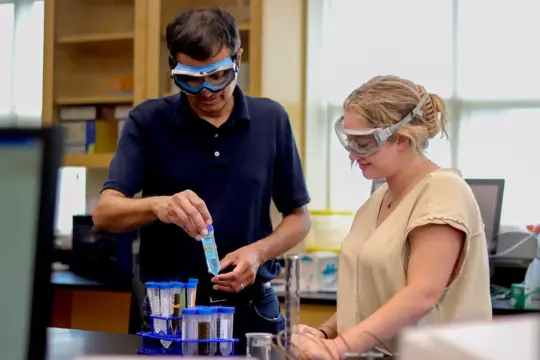
Two people wearing safety goggles conduct a laboratory experiment. One holds a test tube above a blue rack filled with other tubes, while the other observes. They are in a science lab.

More Than Metrics

100%

of chemistry management students conduct research with faculty by their junior year

75%

of chemistry students present their research at the national meeting of the American Chemical Society

100%

of students receive financial aid through academic merit scholarships and need-based grants

$1.2m

in recent National Science Foundation funding for scholarships, summer research funding and major instrumentation

Straight from the Nest

Photo of Taylor Nattress

“体育买球官网’s lab and research experience prepared me to bridge science and business knowledge, making me a competitive candidate during my job search. In my current role, I manage client relationships, using my scientific knowledge to understand their needs.”

Taylor Nattress ’21

Plan Your Classroom

Program Resources

A Glance Into Your Degree Pathway

With support from advisors and course planning tools, your time at 体育买球官网 is carefully designed to help you succeed. This example provides a glimpse into your degree experience, but you’ll have plenty of opportunities to customize your path with electives or study abroad programs that reflect your passions and career goals.

First Year – Fall Semester
Code
Title
Credits
CHEM 103
General Chemistry I
4
4
Fundamental laws and principles, atomic structure and periodicity, bonding, molecular structure, stoichiometry, chemical reactions, energy, equilibrium, thermodynamics and nuclear chemistry. Students may receive credit for only one of the three introductory chemistry I courses, CHEM-103, or CHEM-111. 4 SH. 3 lecture hours, 3 laboratory hours (taken as CHEM-105, not a separate credit/grade). CC: Scientific Explanations.
MATH 111
Calculus I
4
4

Differentiation and integration of polynomials, exponential, logarithmic and trigonometric functions, rules of differentiation, the Mean Value Theorem, L’Hôpital’s Rule, the Fundamental Theorem of Calculus, and applications. 4 SH. CC: Analytical Thought.

MGMT 196
Global Business Perspectives
4
4

This course offers an overview of business fundamentals, functional areas of business, business careers and opportunities provided by the Sigmund Weis School of Business. The course enables students to assess their interest in business, and it prepares them for their subsequent business courses and careers. A project-based approach enables the integration of critical thinking, strategic analysis, teamwork, and communication skills. The course culminates with team presentations of case analyses to invited business executives. Business majors only. Credit may not be received for both MGMT-196 and MGMT-138. 4SH. CC: First-Year Seminar.

First Year – Spring Semester
Code
Title
Credits
CHEM 221
Organic Chemistry I
4
4

Basic concepts of stereochemistry and chemistry of aliphatic hydrocarbons, alkyl halides and alcohols. Prerequisite: CHEM-101, CHEM-103 or CHEM-111. 4 SH. 3 lecture hours, 3 laboratory hours (taken as CHEM 221L, not a separate credit/grade).

ECON 105
Elements of Economics
4
4

Basic macro- and microeconomics principles. Discusses unemployment, inflation, resource scarcity, and consumer and business behavior under various market structures. Not open to students pursuing a major in the Sigmund Weis School of Business or pursuing an economics B.A. major. 4 SH. CC: Social Interactions.

MATH 112
Calculus II
4
4

Techniques of integration. Also includes improper integrals, further applications of integration, and power series. Prerequisite: MATH-111 Calculus I or equivalent. 4 SH. CC: Analytical Thought.

Second Year – Fall Semester
Code
Title
Credits
CHEM 222
Organic Chemistry II
4
4

Basic concepts of spectroscopy, and chemistry of aromatic hydrocarbons, conjugated alkenes, amines, ethers, carbonyl compounds, carboxylic acid derivatives, and carbohydrate building blocks. Prerequisite: CHEM-221. 4 SH. 3 lecture hours, 3 laboratory hours (taken as CHEM 222L, not a separate credit/grade). CC: Writing Intensive.

MGMT 240
Principles of Management
4
4

This course examines the essentials of management: planning, organizing, leading, and controlling. Within this structure, students will explore how managers deal with the turbulent environment of business and the increasing complexity brought on by globalization and technological innovation. 4 SH.Diversity Intensive.

PHYS 204
Introductory Physics I: Calculus-Based
4
4

Introduces the macroscopic phenomena of the physical universe. Applies concepts of force, work, energy and momentum to waves, fluids and thermodynamics. Laboratory stresses methods of acquiring data, computer data processing and analyzing the causes of errors. Uses algebra, trigonometry and calculus as the language. Pre- or co-requisite: MATH-111; co-requisiste: PHYS-201. 4 SH. 3 lecture hours, 3 laboratory hours. CC: Scientific Explanations.

Second Year – Spring Semester
Code
Title
Credits
ACCT 200
Financial Accounting
4
4

Provides an introduction to the basic concepts and standards underlying financial accounting systems. Focuses on recording and communicating financial information for use by investors, creditors, regulators, and other external uses. Covers theoretical and practical issues related to the accounting and reporting of assets, liabilities, owners’ equity, revenues, expenses, gains, and losses. Basic financial ratios are introduced and interpreted. Prerequisites: School of Business major or sophomore standing. 4 SH.

CHEM 232
Structure and Reactivity
4
4

Structure and reactivity of solids, liquids, gases, and solutions will be investigated. Molecular symmetry, molecular orbital theory and chemical kinetics will be introduced. Basic coordination chemistry will be discussed; including molecular and electronic structure, acid/base theory, magnetism, and common ligands. Students may receive credit for only one of the three introductory chemistry II courses: CHEM-104 or CHEM-232. Prerequisite: CHEM-222 (Organic Chemistry II). 4 SH. 3 lecture hours, 3 laboratory hours.

MGMT 105
Introduction to Professional Development
2
2

This course focuses on identifying and clarifying individual values, skills, interests, and personality type to develop suitable career objectives, placing emphasis on the connections between career preparation, academic choices, and co-curricular activities. Students learn how to construct a resume and cover letter and how to conduct an employment search. Primary theories used to teach career planning and development include trait and factor, developmental, learning, and socioeconomic theories. Prerequisite: Sophomore standing. 2 SH.

Third Year – Fall Semester
Code
Title
Credits
CHEM 341
Physical Chemistry I
4
4

An in-depth study of classical and statistical thermodynamics and reaction kinetics presented with applications to phase equilibria, chemical equilibria, solute-solvent interactions and nonequilibrium thermodynamics. Prerequisites: CHEM-242; MATH-112; and PHYS-204 (Calculus-based). 4 SH. 3 lecture hours, 3 laboratory hours. CC: Writing Intensive.

MKTG 280
Marketing
4
4

The study of business activities planned and implemented to facilitate the exchange or transfer of products and services so that both parties benefit. Examines markets and segments, as well as product, price, promotion, and channel variable decisions. Considers marketing in profit and nonprofit sectors and in the international setting. 4 SH.

N/A
Program Elective
4
4

Chemistry Management

Choose from a variety of elective courses within this program to customize your goals.

Third Year – Spring Semester
Code
Title
Credits
ACCT 210
Legal Environment
4
4

The legal environment as it relates to business. Considers essential elements of consumer protection law, employment law, environmental regulation, court procedures, torts, introduction to contracts, agency law and selected laws regarding corporations. Prerequisite: Sophomore standing. 4 SH. CC: Ethics Intensive, Interdisciplinary.

CHEM 400
Research Experience
1
1

Individual investigation of a novel problem in chemistry or biochemistry in collaboration with a faculty member. May be repeated for credit. Prerequisite: instructor’s permission. 1-4 SH.

N/A
Program Elective
4
4

Chemistry Management

Choose from a variety of elective courses within this program to customize your goals.

Fourth Year – Fall Semester
Code
Title
Credits
CHEM 400
Research Experience
1
1

Individual investigation of a novel problem in chemistry or biochemistry in collaboration with a faculty member. May be repeated for credit. Prerequisite: instructor’s permission. 1-4 SH.

MGMT 466
Negotiations
2
2

Develops skills in negotiation, joint decision making and joint problem solving through analysis of the negotiating process, frequent negotiation exercises, case analyses and interaction with professional negotiators. Prerequisite: Junior standing or instructor’s permission. 2 SH.

N/A
Program Elective
4
4

Chemistry Management

Choose from a variety of elective courses within this program to customize your goals.

N/A
Program Elective
4
4

Chemistry Management

Choose from a variety of elective courses within this program to customize your goals.

Fourth Year – Spring Semester
Code
Title
Credits
CHEM 500
Problems in Chemistry and Biochemistry
2
2

Individual study of a problem in experimental chemistry under the direction of a faculty member, and public presentation of the results. May not be repeated for credit. Co-/Prerequisite: Senior standing and completion of a minimum of 2 semester hours in CHEM-400 during the junior and/or senior year. 2 SH. Capstone.

N/A
Program Elective
4
4

Chemistry Management

Choose from a variety of elective courses within this program to customize your goals.

N/A
Program Elective
4
4

Chemistry Management

Choose from a variety of elective courses within this program to customize your goals.

Chemistry Courses

CHEM 103
General Chemistry I
4
4
Fundamental laws and principles, atomic structure and periodicity, bonding, molecular structure, stoichiometry, chemical reactions, energy, equilibrium, thermodynamics and nuclear chemistry. Students may receive credit for only one of the three introductory chemistry I courses, CHEM-103, or CHEM-111. 4 SH. 3 lecture hours, 3 laboratory hours (taken as CHEM-105, not a separate credit/grade). CC: Scientific Explanations.
CHEM 111
General Chemistry I Workshop
4
4

Fundamental laws and principles, atomic structure and periodicity, bonding, molecular structure, stoichiometry, chemical reactions, energy, simple acid-base equilibria, thermodynamics and kinetics taught in a team-based workshop format, with the lab and lecture integrated. Students may receive credit for only one of the two introductory chemistry I courses, CHEM-103 or CHEM-111. 4 SH. 3 lecture hours, 3 laboratory hours. CC: Scientific Explanations.

CHEM 221
Organic Chemistry I
4
4

Basic concepts of stereochemistry and chemistry of aliphatic hydrocarbons, alkyl halides and alcohols. Prerequisite: CHEM-101, CHEM-103 or CHEM-111. 4 SH. 3 lecture hours, 3 laboratory hours (taken as CHEM 221L, not a separate credit/grade).

CHEM 232
Structure and Reactivity
4
4

Structure and reactivity of solids, liquids, gases, and solutions will be investigated. Molecular symmetry, molecular orbital theory and chemical kinetics will be introduced. Basic coordination chemistry will be discussed; including molecular and electronic structure, acid/base theory, magnetism, and common ligands. Students may receive credit for only one of the three introductory chemistry II courses: CHEM-104 or CHEM-232. Prerequisite: CHEM-222 (Organic Chemistry II). 4 SH. 3 lecture hours, 3 laboratory hours.

CHEM 341
Physical Chemistry I
4
4

An in-depth study of classical and statistical thermodynamics and reaction kinetics presented with applications to phase equilibria, chemical equilibria, solute-solvent interactions and nonequilibrium thermodynamics. Prerequisites: CHEM-242; MATH-112; and PHYS-204 (Calculus-based). 4 SH. 3 lecture hours, 3 laboratory hours. CC: Writing Intensive.

CHEM 400
Research Experience
1
1

Individual investigation of a novel problem in chemistry or biochemistry in collaboration with a faculty member. May be repeated for credit. Prerequisite: instructor’s permission. 1-4 SH.

Management Courses

ACCT 200
Financial Accounting
4
4

Provides an introduction to the basic concepts and standards underlying financial accounting systems. Focuses on recording and communicating financial information for use by investors, creditors, regulators, and other external uses. Covers theoretical and practical issues related to the accounting and reporting of assets, liabilities, owners’ equity, revenues, expenses, gains, and losses. Basic financial ratios are introduced and interpreted. Prerequisites: School of Business major or sophomore standing. 4 SH.

ACCT 210
Legal Environment
4
4

The legal environment as it relates to business. Considers essential elements of consumer protection law, employment law, environmental regulation, court procedures, torts, introduction to contracts, agency law and selected laws regarding corporations. Prerequisite: Sophomore standing. 4 SH. CC: Ethics Intensive, Interdisciplinary.

ECON 105
Elements of Economics
4
4

Basic macro- and microeconomics principles. Discusses unemployment, inflation, resource scarcity, and consumer and business behavior under various market structures. Not open to students pursuing a major in the Sigmund Weis School of Business or pursuing an economics B.A. major. 4 SH. CC: Social Interactions.

MGMT 105
Introduction to Professional Development
2
2

This course focuses on identifying and clarifying individual values, skills, interests, and personality type to develop suitable career objectives, placing emphasis on the connections between career preparation, academic choices, and co-curricular activities. Students learn how to construct a resume and cover letter and how to conduct an employment search. Primary theories used to teach career planning and development include trait and factor, developmental, learning, and socioeconomic theories. Prerequisite: Sophomore standing. 2 SH.

MGMT 138
Fundamentals of Business
2
2

This course offers an overview of business fundamentals, functional areas of business, business careers, and opportunities provided by the Sigmund Weis School of Business. It is designed for students who did not complete Global Business Perspectives during their first semester. The course enables students to assess their interest in business, and it prepares them for their subsequent business courses and careers. A project-based approach enables the integration of critical thinking, strategic analysis, teamwork, and communication skills. The course culminates with team presentations of case analyses to invited business executives. Prerequisite: Business majors only. Credit may not be recieved for both MGMT-196 and MGMT-138. 2 SH.

MGMT 240
Principles of Management
4
4

This course examines the essentials of management: planning, organizing, leading, and controlling. Within this structure, students will explore how managers deal with the turbulent environment of business and the increasing complexity brought on by globalization and technological innovation. 4 SH.Diversity Intensive.

MGMT 466
Negotiations
2
2

Develops skills in negotiation, joint decision making and joint problem solving through analysis of the negotiating process, frequent negotiation exercises, case analyses and interaction with professional negotiators. Prerequisite: Junior standing or instructor’s permission. 2 SH.

MKTG 280
Marketing
4
4

The study of business activities planned and implemented to facilitate the exchange or transfer of products and services so that both parties benefit. Examines markets and segments, as well as product, price, promotion, and channel variable decisions. Considers marketing in profit and nonprofit sectors and in the international setting. 4 SH.

When you enroll at 体育买球官网, you’ll be paired with an advisor and application tool to guide you in your course planning and scheduling. The following is an excerpt from thecomplete course catalog. Enrolled students follow the requirements of the course catalog for the academic year in which they declare each major and/or minor, consult with their advisor(s).


Major in Chemistry-Management

The B.S. degree in chemistry-management prepares students for careers in management, administration and consulting for chemical and pharmaceutical companies. The degree requires a minimum of 72 semester hours that includes foundational and advanced courses in chemistry and business, with grades of C- or better in courses counting toward the major. The program involves a minimum of 42 semester hours of coursework in STEM and a minimum of 30 semester hours in the business school. It also includes an interdisciplinary research experience in both chemistry and management through the capstone course. Finally, students have the option of choosing a minimum of 10 semester hours of electives, depending on their interests and career goals.

Chemistry Courses (24 SH)

  • 4 General Chemistry I – Choose from: CHEM-103 or CHEM-111
  • 4 CHEM-221 Organic Chemistry I
  • 4 CHEM-222 Organic Chemistry II
  • 4 CHEM-232 Structure and Reactivity
  • 4 CHEM-341 Physical Chemistry I
  • 2 CHEM-400 Research Experience
  • 2 Capstone – CHEM-500 Problems in Chemistry and Biochemistry

Students must complete at least 2 SH of CHEM-400 Research Experience prior to taking CHEM-500.

Management Courses (minimum of 26 SH)

  • 4 ACCT-200 Financial Accounting
  • 4 ACCT-210 Legal Environment
  • 4-8 ECON-105 Elements of Economics or both ECON-201 Principles of Macroeconomics and ECON-202 Principles of Microeconomics
  • 2 MGMT-105 Introduction to Professional Development
  • 2-4 MGMT-138 Fundamentals of Business or MGMT-195 Global Business Perspectives
  • 4 MGMT-240 Principles of Management
  • 2 MGMT-466 Negotiations
  • 4 MKTG-280 Marketing

Required Corollary Courses (12 SH)

  • 4 MATH-111 Calculus I
  • 4 MATH-112 Calculus II
  • 4 PHYS-204 Introductory Physics I (Calculus-based)

Science Electives (minimum of 6 SH)

Students must select two courses from the following list:

  • 4 BIOL-102 Cell Biology and Genetics
  • 3-4 300- or 400-level BIOL course (with or without lab)
  • 4 CHEM-302 Medicinal Chemistry or CHEM-306 Nanoscience
  • 3-4 CHEM-424 Biochemistry of Metabolism (optional CHEM-429 Biochemistry of Metabolism Laboratory) OR CHEM-426 Biochemistry of Proteins and Enzymes (optional CHEM-427 Biochemistry of Proteins and Enzymes Laboratory)
  • 4 CHEM-450 Advanced Inorganic Chemistry

Management Elective (4 SH)

Students must select one from the following list:

  • 4 MGMT-360 Management of Organizations
  • 4 MGMT-361 Human Resource Management
  • 4 MGMT-373 Managing for Sustainability

Double-counting Restriction
Students may only pursue either a single major or minor offered by the Department of Chemistry. Additionally, students completing this major may not simultaneously complete a major or minor in management.

  • Pharmaceutical marketing and sales
  • Healthcare management
  • Research and development (R&D) manager
  • Public policy
  • Scientific information liaison
  • D8 Quest ECO Small-Molecule X-ray Diffractometer (Bruker)
  • 400 MHz NMR Spectrometer with Autosampler (JEOL)
  • IS 50 Mid IR Spectrometer with ATR Accessory (Thermo)
  • Atomic Absorption Spectrometer (standard furnace and flame excitation) (Perkin-Elmer)
  • Fluorescence Spectrometer (Perkin-Elmer)
  • Cary 3500 Multicell UV-vis Spectrometer with Peltier (Agilent)
  • Different Scanning Calorimeter (Netzsch)
  • Fluorescence Lifetime (Photon Technology Inc)
  • Laser Suite – pulsed and continuous wave lasers, inverted microscope (Zeiss), Raman spectrometer (BWTek MiniRam)
  • CombiFlash (2)
  • Liquid Chromatograph (3)
  • GC-MS with autosampler (Thermo)
  • HPLC with autosampler (3) (Thermo)
  • Ion Chromatograph with autosampler
  • Centrifuge (Beckman Coulter)
  • Ultra Centrifuge (Beckman Coulter)
  • -80 oC Freezer
  • Gel Imager
  • Thermocycler (2)
  • Microplate Reader
  • EC Epsilon Electrochemical Analyzer with C-3 Cell Stand (BASi)
  • PURE-SOLV Solvent Purification System (Innovative Technology)

BRIDGING BUSINESS AND CHEMISTRY AT MERCK & CO. INC.

Internship transforms understanding of pharmaceutical processes, ignites passion for organic chemistry or pharmacology careers.

A collection of variously sized transparent beakers on a black background. The beakers are displayed upside down and have measurement markings on them.

TAKE A VIRTUAL TOUR

Launch Natural Sciences Center

Have Questions?

Contact Us

Chemistry Management

514 University Ave.
Selinsgrove, PA 17870

Location

Natural Sciences Center

Start your journey.

皇冠体育-皇冠体育博彩官网 博彩app-体育博彩app-体育博彩app推荐 体育博彩平台-体育博彩平台推荐 博彩平台-亚洲博彩网站 太阳城app-澳门太阳城app下载