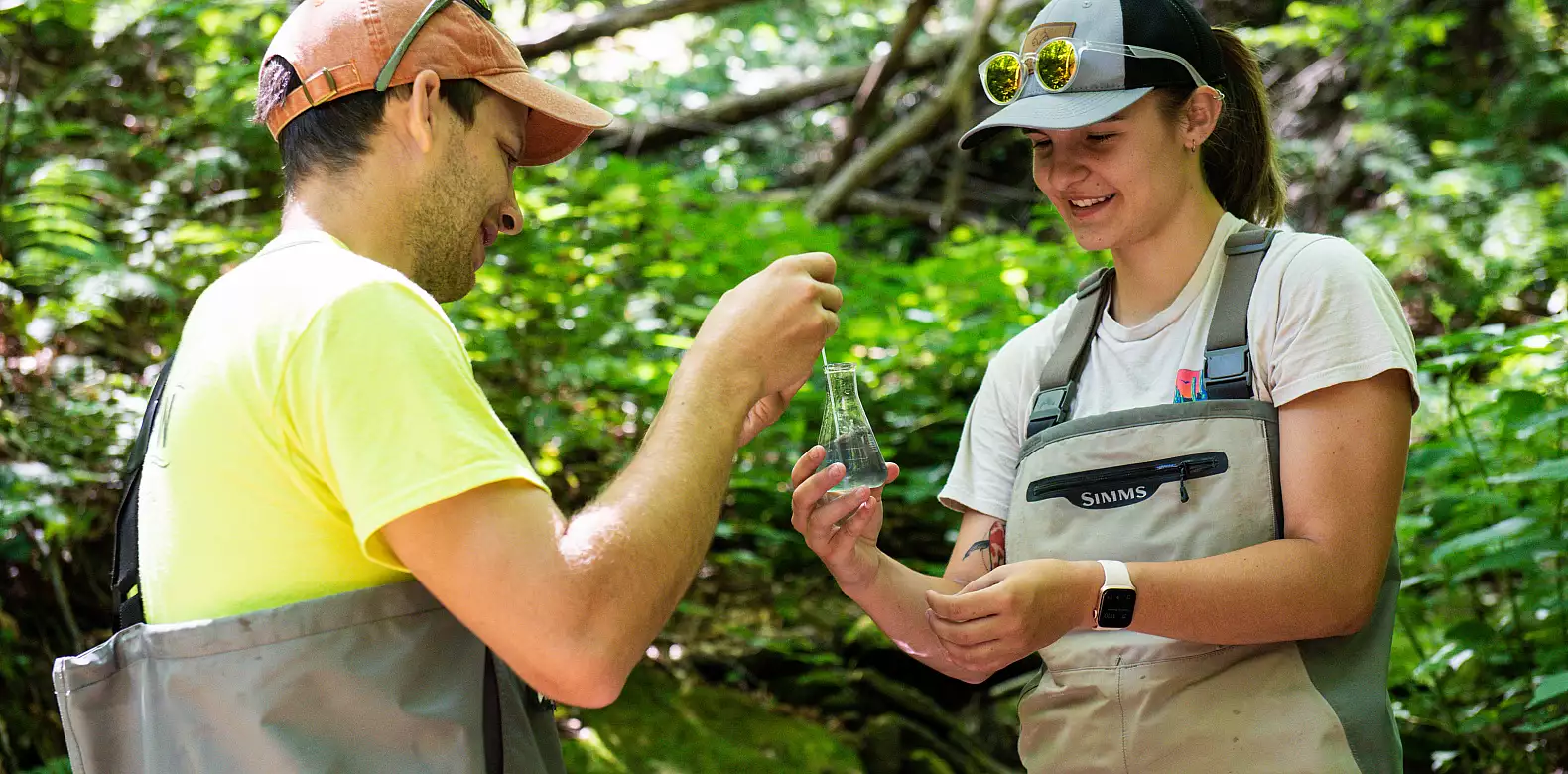
Testing the quality of your water just got easier and less expensive thanks to a first-of-its-kind application. The free, easy-to-use app, called Turbidivision, can measure the turbidity, or cloudiness, of water through user-uploaded images.
The app was developed by recent 体育买球官网 graduate Ian Rudy ’24 under the guidance of Matt Wilson, director of 体育买球官网 University’s Center for Environmental Education and Research.
“In fields ranging from environmental science to public health, assessing water quality is vital,” Wilson said. “These tests often begin with measuring turbidity, which can impact water clarity and drinkability.”
Estimated by the scattering of light by particles suspended in water, turbidity is an optical measure of water clarity, Wilson explained. In nature, many of these particles are agitated sediment, such as clays and soils or suspended organic matter, and largely depend on surrounding land use. Pollutants contained in industrial and agricultural runoff can also be linked to turbidity.
Wilson and Rudy, who graduated from 体育买球官网 with dual degrees in computer science and communications, used a two-step process for their application. First, they trained an image classification model using photos and turbidity measurements. Then, they used a statistical method to estimate turbidity levels from these images.
To create a strong model, they collected images from both field sites and lab experiments under various water conditions and grouped them into 11 categories based on turbidity levels.
“Our classification model is very accurate, with 100% of predictions being close to the true category and 84% being spot-on,” Wilson said. “Current methods for determining turbidity can be costly and time-consuming. Our app could make it easier to analyze old image data and provide a simpler way to asses turbidity, especially for educational and citizen science projects where high accuracy isn’t always necessary.”
The application developed as part of this research project is the first photo-based turbidity-measuring tool accessible to the public. To make the model widely accessible, Wilson and Rudy implemented it as a free, user-friendly web application. The app is compatible with a wide range of devices and has a simple user interface, allowing anyone to easily benefit from the results of this research.
Wilson and Rudy wrote an article on their app development project, which was just published in the journal PeerJ. The app is available on the web and from Google Play.