While awaiting the delivery of the physics components that were delayed due to supply shortages, Cory “Jackson” Mabry ’24 did what any other undergraduate student would have done: he read and reread an 84-page master’s thesis submitted to MIT until he understood it. The summer research project was inspired by the author, and Mabry admitted he had a lot to learn.
“I used the thesis as my starting point,” Mabry said from the 体育买球 University lab. “Dr. Hansell wanted me to understand the project, and I wanted to understand particle physics.”
A few years ago, Assistant Professor of Physics Adam Hansell was one of about 80 graduate students creating a grid of large devices that detected muons — decayed particles produced when cosmic rays collide with the atmosphere — and their interference with signals near a nuclear reactor.
“This summer, I wanted to make smaller, more accessible devices while providing a learning opportunity where students can take complete ownership and build their confidence,” Hansell said. “At the end, I wanted the students to say, ‘We did this.’”
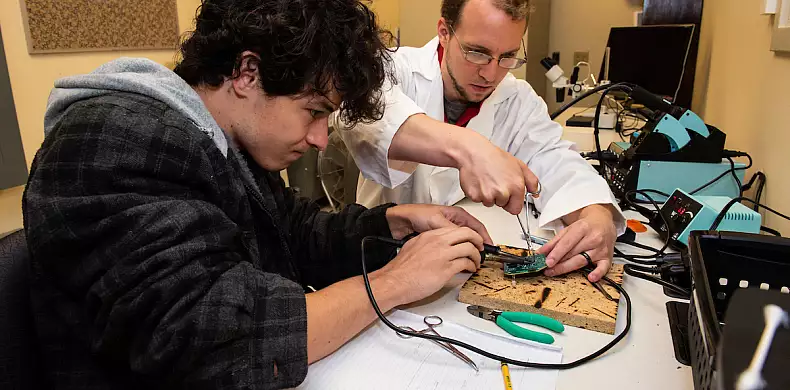
One of the first skills Mabry had to master was “soldering tiny, tiny pieces to a circuit board.” Assembling and testing the circuit board for the pocket-sized detector included varying amounts of troubleshooting along the way. The LED display flashes every time a cosmic ray goes through the detector, and readings can be compiled on a data card.
Charged with building a protective case for the circuit board, Mandy McLaughlin ’23 did not have precise measurements to reference; instead, she had to work from a 3D printer diagram and scale it to size — while also learning 3D schematics and slicing techniques.
“This was my first time working with a 3D printer,” McLaughlin said. “I had to do a lot of research on my own to build the prototype. After problem-solving, printing additional models and sometimes adjusting miniscule drill holes by 1 millimeter, the box fit perfectly.”
McLaughlin is developing a 3D-printing specifications guide for the detector, and the team plans to share it with Spencer Axani, author of the thesis paper and research assistant at MIT.
Looking ahead to next year, Hansell aims to build more detectors — enough to make a grid and measure the angles at which cosmic rays come in — and test materials that can act as a shield.
“At this size, most of the components cost pennies to build,” Hansell said. “We can scale up production, and attach detectors to a drone to measure cosmic rays at different heights and temperatures and across varying levels of barometric pressure.”
McLaughlin, a physics major in the 3+2 engineering program, will be at one of the partnering schools pursuing her master’s degree by then, but Mabry said he is “interested in taking it a step further next summer.” He added that he appreciated Hansell’s hands-off approach, saying, “He offered support and was there if I needed him, but he treated it like it was my research, which I liked.”